Osteopathy
An individual approach to pain, mobility and function, looking at the body as a whole.
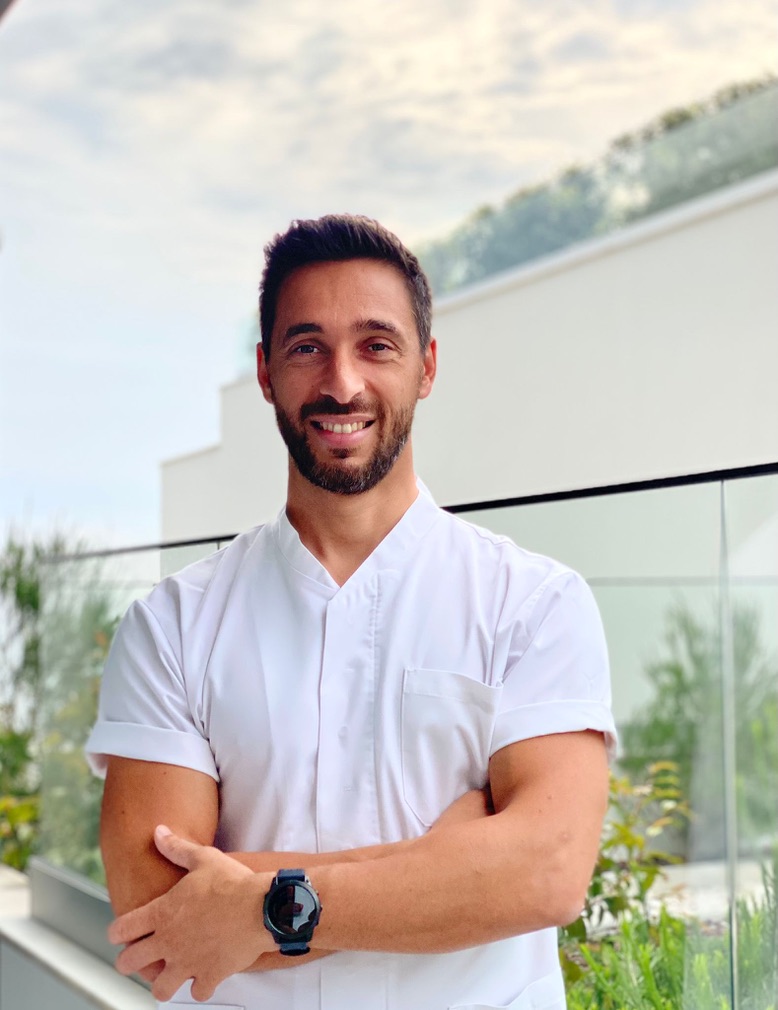
João Paulo Oliveira dos Santos
João's approach was born from movement. A federated athlete and, later, a paratrooper sergeant for seven years in the Portuguese Army, he knows first-hand physical demand, injury and the importance of recovering to keep doing what we love. That experience became the passion that guides his practice today.
He comes from sport - athletics, handball, volleyball, taekwondo, capoeira, acrobatic gymnastics and calisthenics - and from seven years as a paratrooper sergeant in the Portuguese Army, where he tested his own limits.
Before health, he studied Multimedia Engineering at ISTEC and photography and video at CENJOR. That link to the digital world remains to this day and is also at the origin of the Health Lab Platform, designed to follow health beyond the consulting room.
He is an osteopath with a degree from Escola Superior de Saúde Ribeiro Sanches and has been in clinical practice since 2013. He follows people from age 5, with different needs and activity levels, including CrossFit athletes, runners, ultramarathoners and powerlifters.
His experience in the Jerónimo Martins Wellbeing project also took him into the corporate setting, managing and coordinating multidisciplinary health teams - the experience behind Health Lab's corporate health work.
Continuous training is part of his practice, with specialisations in Functional Footmap and Anatomy Trains among other complementary areas. His approach seeks to understand each person in context, relating symptoms, movement, function and clinical history to define an individual intervention - not a generic protocol.
5.0 stars on Google
85 reviews on Google, with an average of 5.0. Thank you for your trust.
★★★★★“More than treating pain or discomfort, he helped me understand my body better and gave me tools to look after it day to day. […] I leave the appointments not only better, but also more able to prevent and manage small problems before they become bigger.”
Paula H. · Google
★★★★★“I have had cervical problems for a long time and, for years, dealt with pain that affected my daily life. Since I started osteopathy sessions with João, the difference has been enormous. I feel much better, with less pain and far more mobility.”
Paula G. P. · Google
★★★★★“I started feeling improvement and relief from the first sessions […] and I already notice visible differences in my posture. Each session is almost like a lesson: I learn a lot about the human body in general and mine in particular. I have already recommended João to several friends, and I think that says it all.”
Ana Margarida N. · Google
Translated from the original Portuguese reviews on Google.
What you need to know.
How long does an osteopathy appointment last?
The first appointment lasts about 75 minutes, to allow a complete assessment. Follow-up appointments last about 60 or 90 minutes, depending on the follow-up needed.
Do I need a medical referral to see an osteopath?
No. In Portugal, no medical referral is needed to book an osteopathy appointment. Whenever we identify the need for assessment by another health professional, we refer you accordingly.
Can I use my health insurance?
It depends on your policy. Osteopathy may be included in non-conventional therapies or alternative medicine cover, but conditions vary between insurers and plans. We recommend checking directly with your insurer before the appointment.
What documents do I need to claim a refund?
We issue an invoice-receipt with your tax number (NIF) and the required professional details. Some insurers may also ask for a medical prescription or additional documentation, so we recommend checking the conditions of your policy beforehand.
Can I deduct osteopathy on my Portuguese tax return (IRS)?
Yes. As of October 2026, osteopathy appointments provided by a duly qualified professional can be considered health expenses for IRS purposes, under the applicable terms. The invoice must include your NIF and be correctly reported in e-Fatura. Tax information updated in October 2026 and subject to change.
What should I wear? Do I need shorts?
You do not need specific clothing. We only recommend comfortable clothes that make it easy to assess movement. If needed, we provide a solution so you feel comfortable during the appointment.
Should I bring exams or reports?
Yes, if you have them. X-rays, MRIs, ultrasounds, lab results or relevant medical reports can help us understand your history better. Also bring information about the medication you currently take.
From what age do you see patients?
At Health Lab we see people from age 5. Children and adolescents must be accompanied by an adult. For younger ages, we recommend a professional with specific training in paediatrics.
Do the techniques hurt? Will you "crack" me all over?
Not necessarily. Techniques are chosen and adapted to each person, taking into account the assessment, the purpose of the appointment and your tolerance. Joint manipulation is only one of the techniques that may be used and is not always indicated or necessary. If any technique causes you discomfort or apprehension, tell us - communication is part of the appointment.
What is the difference between osteopathy and massage?
Massage acts mainly on soft tissues and may aim at relaxation or relief of muscle tension. Osteopathy starts from a clinical and functional assessment and may use different manual techniques, chosen according to each person's needs.
How many appointments will I need?
There is no single number for everyone. It depends on the reason for the appointment, the initial assessment, your goals and how things evolve during follow-up. After the first appointment, we explain what we found and, when needed, propose the next steps.
What is osteopathy?
Osteopathy is a manual approach that assesses the body as a whole and seeks to support its capacity for self-regulation.
Contemporary osteopathic practice has its origin in a set of principles developed over its history.
They are not Still's. They were published in 1953 by a committee of the Kirksville College of Osteopathy and Surgery, as a later systematisation of his philosophy.4 A revised version, used by AACOM's ECOP, speaks of the human being as a dynamic unit of function and of self-regulating mechanisms that are self-healing in nature; some authors criticise the 1953 wording for being little distinctive of osteopathy.5
Body, mind and context work as a whole. A change in one part can show up in the whole, which is why the assessment looks at the entire person.
The organism tends to regulate and repair itself. The osteopath's work is to seek to remove what hinders those mechanisms, not to replace them.
How the body is organised shapes how it works, and the use we make of it shapes its structure. The two are read together.
The intervention follows from the assessment, not from a protocol that is the same for everyone: each plan answers what was found in that person.
Osteopathy was born in the United States at the end of the 19th century with Andrew Taylor Still, a physician who sought a way of treating centred on the structure and function of the body. In 1892 he founded the first school of osteopathy in Kirksville, Missouri. His observations gave rise to the principles the profession would later systematise.
Still's principles and observations
- Find health, not disease. “To find health should be the object of the doctor. Anyone can find disease.”2 Finding health should be the aim of whoever treats; anyone can find disease.
- Structure governs function. Anatomy is the basis of clinical reasoning: changes in structure show up in function.
- Free circulation. “The rule of the artery is absolute, universal, and it must not be obstructed.”1 Unobstructed blood, lymphatic and nervous flow is a condition of health.
- The body as a unit. With its own capacity for self-regulation. The osteopath seeks to remove obstacles to the body's functioning, not to “cure”.
The rule of the artery
A maxim of the osteopathic tradition, often quoted as “the rule of the artery is supreme”. That exact wording does not appear in Still's writings.3 The closest passage is in the 1897 Autobiography: the rule of the artery is absolute and universal, and it must not be obstructed.1 We present it as a maxim of the tradition based on Still, not as a direct quotation.
Fryette's laws
Three laws of vertebral mechanics, used to describe how vertebrae move together: the first two formulated by Harrison Fryette in 1918, the third by C. R. Nelson in 1948.6 They are not Still's and should not be confused with his principles.
- First law. In a neutral position, side-bending and rotation of a group of vertebrae occur to opposite sides.
- Second law. In marked flexion or extension, side-bending and rotation of a vertebra occur to the same side.
- Third law (Nelson). Initiating movement in one plane reduces the range available in the other two.
References (6)
- Still AT. Autobiography of Andrew T. Still. Kirksville, MO: publicado pelo autor; 1897. p. 219.
- Still AT. Philosophy of Osteopathy. Kirksville, MO: publicado pelo autor; 1899. p. 28. Texto integral: gutenberg.org/files/25864/25864-h/25864-h.htm
- Rogers FJ. The Rule of the Artery Is Supreme. Or, Is It? J Osteopath Med. 2018;118(7):429-430. doi:10.7556/jaoa.2018.095
- Special Committee on Osteopathic Principles and Osteopathic Technic, Kirksville College of Osteopathy and Surgery. The osteopathic concept: an interpretation. J Osteopathy. 1953;60:7-10.
- Paulus S. The core principles of osteopathic philosophy. Int J Osteopath Med. 2013 (S1746-0689(12)00070-3).
- Fryette HF. Principles of Osteopathic Technic. Carmel, CA: Academy of Applied Osteopathy; 1954 (reedição; ano da edição original por confirmar).
Health Lab's approach rests on five pillars.
Health Lab looks at health as a whole - movement, sleep, stress, nutrition and relationships. They are the same pillars the platform follows.
Explore the pillarsBook your appointment.
Choose the type of appointment, the day and the time directly in the calendar.
We have no reception desk; if you have any questions, send us a message on WhatsApp.